How to Improve Disc Golf Wayfinding
A player should not have to stand beside Hole 6 wondering whether Hole 7 is behind the pavilion, across the road, or halfway up the hill. That moment of hesitation slows pace of play, frustrates first-time visitors, and makes even a well-designed course feel unfinished. If you are asking how to improve disc golf wayfinding, the answer usually is not one bigger sign. It is a coordinated system that helps players move confidently from parking lot to final basket.
For clubs, park departments, and course managers, wayfinding is more than a cosmetic upgrade. It affects player experience, event readiness, safety, course reputation, and maintenance calls. When navigation is clear, the course feels professional. When it is inconsistent, every missing arrow and faded tee sign creates friction that players remember.
How to improve disc golf wayfinding starts with course flow
The first step is to look beyond individual signs and study the full player journey. A course can have attractive tee signs and still be difficult to follow if transitions are awkward, crossings are unclear, or the starting area lacks orientation. Good wayfinding begins before the first throw.
Start where a new player starts – the parking lot, kiosk, or trailhead. Can someone find Hole 1 without local knowledge? Is there a course map visible at the main entry? Are practice areas, restrooms, and event gathering points easy to identify? If the opening experience is confusing, players begin the round already uncertain.
Then walk the course as if you have never seen it before. The trouble spots tend to show up quickly. Long walks between holes, shared park paths, blind exits from wooded greens, and areas where multiple tees sit near each other all need stronger directional support. The goal is simple: after finishing a hole, the next move should feel obvious.
That does not always mean adding more signage everywhere. Too many signs can create visual clutter and still fail to communicate. The better approach is to place the right information at the right decision points.
Build a wayfinding system, not isolated signs
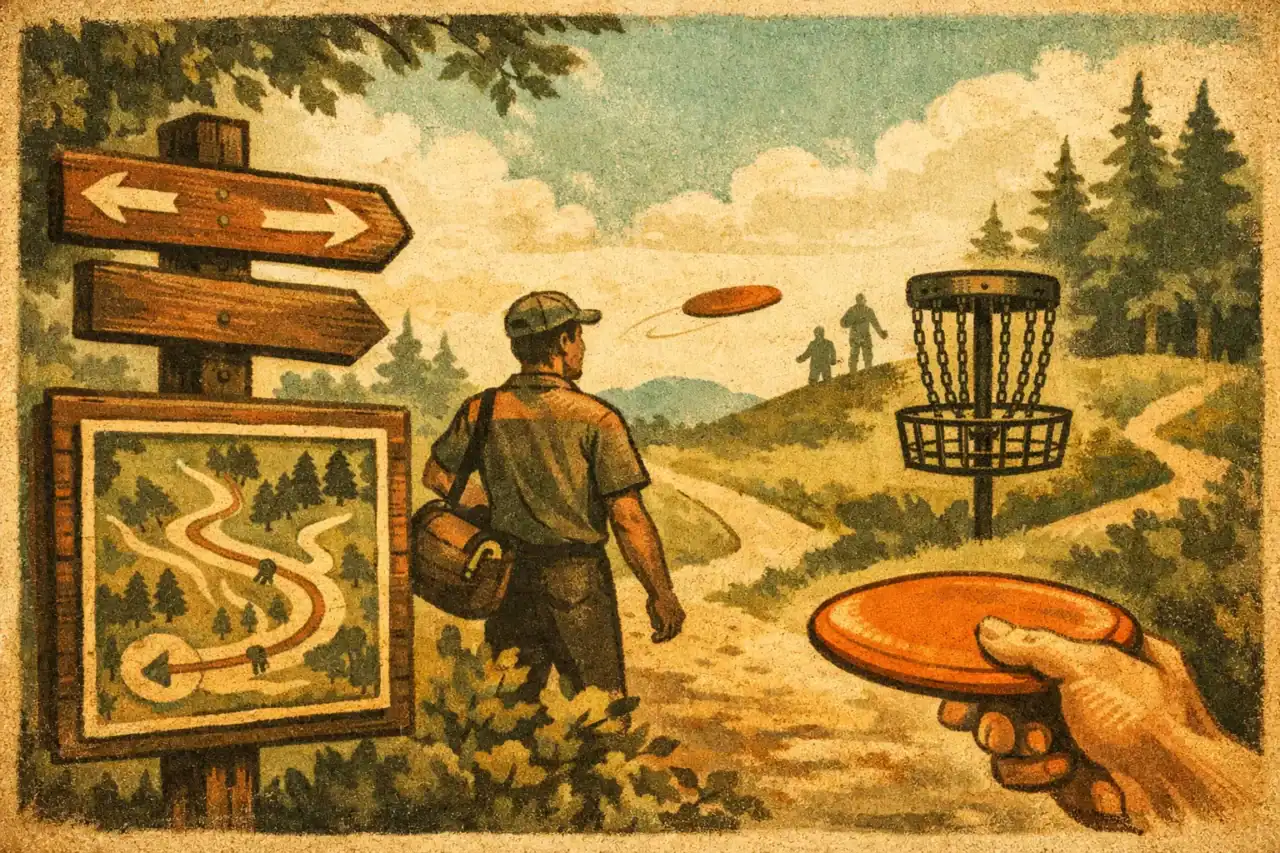
The strongest courses use layered wayfinding. Each sign type has a job, and together they guide players without forcing them to stop and interpret too much information.
A course entry sign or kiosk handles big-picture orientation. It should show the full layout, course rules, and key amenities. Tee signs handle hole-specific information like layout, distance, par, and basket position. Next tee signs or directional arrows handle movement between holes. In larger parks or multi-loop properties, supplemental signs may identify parking, practice baskets, alternate starts, or tournament routes.
This matters because players process information in stages. At the start, they need the big picture. At the tee, they need strategy and confidence. After holing out, they need immediate direction to the next tee. If one sign is trying to do all three jobs, it usually does none of them especially well.
Consistency is what ties the system together. Fonts, colors, icon styles, hole numbers, and arrow treatments should feel unified across the course. That consistency reduces mental effort. Players do not need to relearn the signage language at every stop.
Tee signs should do more than show distance
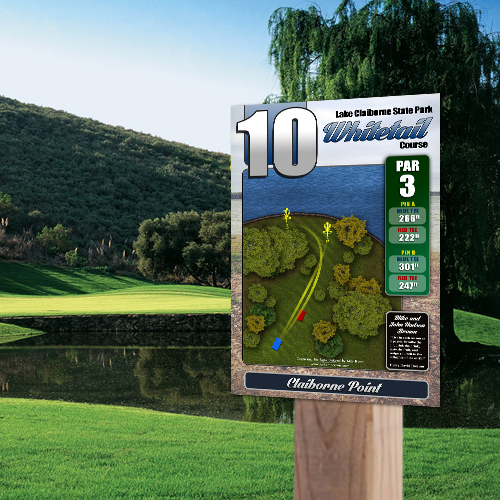
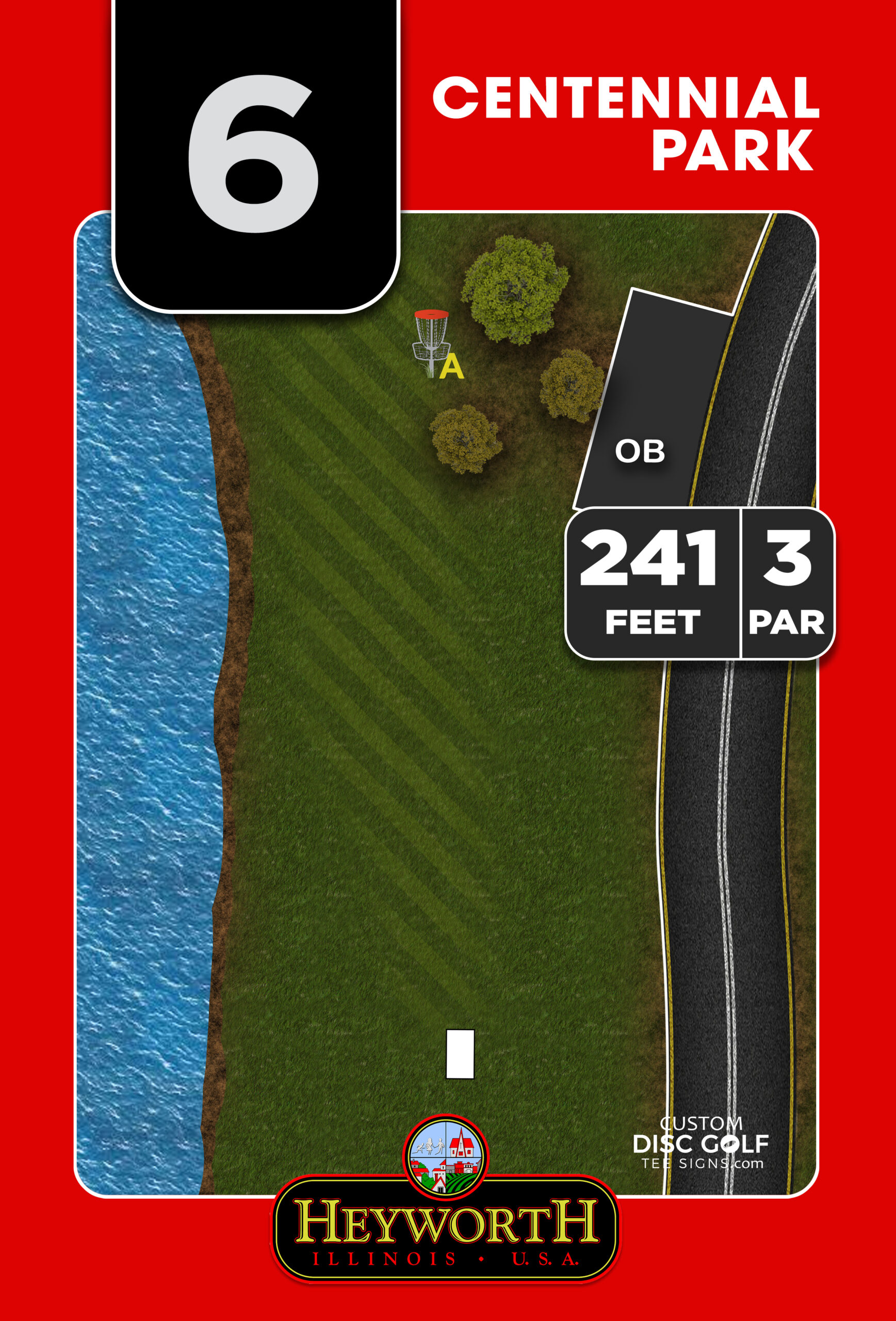
A quality tee sign is one of the most important tools in any wayfinding plan, but many courses ask too little of it. A sign that lists only hole number and footage leaves players guessing about shape, hazards, alternate pin placements, and the intended route.
A stronger tee sign includes a clear hole map, accurate distance, par, directional orientation, and visual landmarks that match what the player sees on the ground. If there are multiple basket positions or tee pads, those need to be shown cleanly. If out-of-bounds areas, mandatory routes, or water carry lines affect play, the sign should make that plain without becoming crowded.
This is where disc-golf-specific design matters. Generic signage layouts often miss the details that actually help players navigate and play the hole correctly. A professionally designed sign can present a lot of information without feeling busy, which is a major difference between a sign that looks nice and one that genuinely improves the course.
Directional signs belong where decisions happen
Players rarely get lost standing on the tee. They get lost after the putt, when they leave the green and hit a fork in the path. That is why directional arrows should be placed at transition points, not simply near the next tee.
If Hole 8 finishes in a wooded pocket and Hole 9 begins across an open field, the arrow belongs at the exit from 8 green, and sometimes again midway through the transition. If a path bends around a shelter, creek, or road crossing, reinforce the route before the player has a chance to second-guess it.
Simple arrows can work well, but they need to be durable, readable, and consistent. Temporary solutions often fade, peel, rotate, or disappear. A permanent wayfinding system saves time because staff and volunteers stop answering the same navigation questions week after week.
Fix the places where confusion creates risk
Some navigation issues are annoying. Others create safety problems. When evaluating how to improve disc golf wayfinding, prioritize any area where a missed turn puts players near roads, active park spaces, maintenance zones, or crossing fairways.
Shared-use parks especially need clear transitions. A new player who wanders onto the wrong trail or crosses into another fairway can create delays and unsafe interactions. In these settings, wayfinding should do two things at once: keep the round moving and keep player traffic predictable.
Blind holes deserve extra attention too. If the basket is hidden and the exit path is not intuitive, players often scatter in different directions after they finish the hole. A small directional sign at the basket area or green exit can solve that immediately. The same applies to courses with alternate tournament layouts, where the casual route and event route may differ.
It depends, of course, on the property. A compact 9-hole community course may need a lighter signage package than a championship layout spread across varied terrain. But every course benefits from identifying the few moments where uncertainty causes the biggest drop in player confidence.
Use design to support branding and sponsorships
Wayfinding is functional first, but it also shapes how the course is perceived. Clean, professional signage tells players the course is cared for. It signals that the club, city, or park department takes the facility seriously.
That presentation matters when you are trying to attract tournament traffic, retain community support, or justify future improvements. It also matters when you approach sponsors. Businesses are far more likely to support a course project when the signage plan looks organized and polished rather than improvised.
Sponsor placement can offset project costs, but it has to be handled carefully. If sponsor logos overpower directional information, wayfinding suffers. The better approach is to build sponsor areas into the sign design from the start, with clear hierarchy so navigation remains the top priority. Done well, sponsorship support helps fund a higher-quality system without making the course feel cluttered.
Material choices affect long-term wayfinding
A beautifully designed sign still fails if it fades quickly, warps, or becomes unreadable after a season of sun and weather. For public courses, durability is part of wayfinding. Players cannot follow what they cannot read.
That is why substrate and print protection matter. Outdoor-rated materials such as aluminum composite or aluminum, paired with UV protection and high-resolution printing, hold up better in demanding environments. The right choice depends on budget, climate, and expected traffic, but short-term savings on low-end materials often lead to replacement costs and inconsistent appearance later.
This is one reason many course leaders prefer a structured signage project over piecemeal replacements. When signs are updated one at a time with different materials, layouts, and mounting styles, the course starts to feel disjointed. A coordinated rollout creates a cleaner player experience and simplifies future maintenance.
A practical process for improving wayfinding
If you want real improvement, start with an audit. Walk the course and note every point where a first-time player could hesitate. Take photos, mark transition trouble spots, and identify which signs are missing, outdated, inaccurate, or visually inconsistent.
Next, separate needs into categories: entry signage, tee signs, directional signs, and special-use signs. This helps you scope the project realistically. Some courses need a full replacement package. Others need targeted upgrades at the worst navigation points first.
Then verify the actual course data. Distances, basket positions, paths, and hole maps should reflect the course as it exists now, not how it looked three layout changes ago. Inaccurate information creates just as much confusion as no information.
Finally, think through approvals and funding early. Municipal courses, state parks, and club-led projects often involve multiple stakeholders. A sign partner that can support proofing, custom layouts, and sponsor-ready designs can make that process much smoother. Custom Disc Golf Tee Signs works with that kind of structured workflow because course improvements usually move faster when everyone can review clear visuals before production begins.
The best wayfinding systems do not call attention to themselves. They simply make the course feel easy to read, easy to trust, and ready for more play. If your players are asking where to go next, your course is telling you exactly where to start.