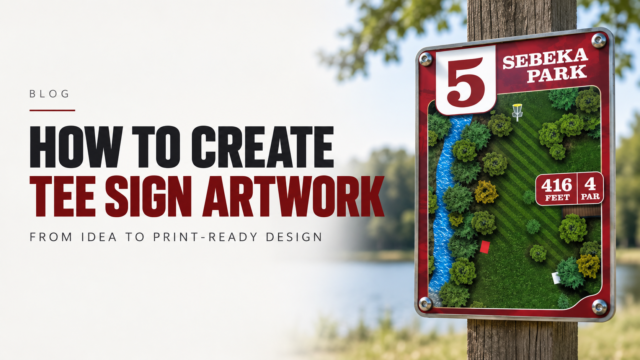
A tee sign that looks great on install day can start failing faster than most course teams expect. After one hot summer, colors dull, black text softens to gray, and hole maps lose the contrast players rely on at the tee. That is why uv resistant disc golf signs are not a premium extra for serious courses – they are a practical requirement.
For park departments, clubs, and course managers, sign performance is not just about appearance. It affects navigation, player confidence, sponsorship value, and how the entire property is perceived. When signs fade early, the course starts to feel neglected, even if the layout itself is strong. Good sign design matters, but material protection is what keeps that design working in the field.
What UV resistant disc golf signs actually solve
Sun exposure does not damage every sign all at once. It usually happens in layers. First, bright colors lose depth. Then fine details get harder to read. Eventually, logos, distances, next-tee directionals, and out-of-bounds notes become less useful because contrast drops.
That decline creates real problems on the course. New players depend on tee signs for orientation. Tournament players use them to confirm landing zones and hazards. Sponsors expect their brand to remain visible and professional. If a sign is technically still standing but no longer clear, it is already underperforming.
UV resistant disc golf signs are built to slow that process significantly. The goal is straightforward – preserve legibility, preserve color, and extend the time before replacement becomes necessary. For buyers managing public budgets or volunteer-led projects, that longer usable life matters as much as the initial print quality.
Why standard outdoor printing is often not enough
A common mistake in course signage projects is assuming that any outdoor-rated print is suitable for long-term disc golf use. In reality, there is a big difference between a sign that can survive outside and a sign that can remain sharp and readable through years of direct sun, seasonal heat, and changing weather.
Disc golf courses create a demanding environment because exposure is inconsistent. Some tees sit in open sun all day. Others get partial shade that shifts by season. South-facing holes often take more direct punishment than sheltered areas. A sign package has to perform across all of those conditions, not just the easier ones.
This is where substrate choice and protective finishing start to matter. UV protection is part of the system, not a single feature. The print method, the inks, the laminate or coating, and the panel material all influence how well the final sign holds up. If one piece of that system is weak, the whole sign ages faster.
Material choices affect more than durability
When buyers compare signage options, they often focus on size, shape, or price first. Those are important, but material selection usually has more impact on long-term satisfaction. A well-designed sign printed on the wrong substrate can still become a replacement project sooner than planned.
Aluminum composite is a popular choice for many disc golf courses because it offers a strong balance of rigidity, clean print presentation, and weather resistance. Solid aluminum can also be an excellent fit, especially where maximum toughness is a priority. The right answer depends on the course setting, mounting method, budget, and expected lifespan.
There is always a trade-off. Lower-cost materials may help get a project approved faster, especially for volunteer-run installs or early-stage course upgrades. But if that lower price leads to visible fading, edge wear, or a shorter replacement cycle, the savings can disappear quickly. For courses trying to raise their presentation standard, the better value is usually the option that holds its appearance over time.
UV resistance protects the player experience
Most people think about sign fading as a cosmetic issue. On a disc golf course, it is more than that. Tee signs are functional infrastructure. They tell players where they are, what the hole asks of them, and where to go next.
When maps become washed out, players hesitate at the tee. When directional arrows fade, backups increase. When distances and pars become harder to read, the course feels less organized. None of that helps a new player have a better first round, and it does not support tournament readiness either.
UV resistant disc golf signs help preserve consistency across the entire property. That consistency matters because players judge the course as a whole. One faded sign may be ignored. A full course of mismatched, aging signs sends a different message. It suggests that maintenance is reactive instead of planned.
For municipalities and park systems, this also affects public perception. Clean, readable signage supports the idea that the course is a legitimate recreational asset, not an improvised amenity. That can make a difference when departments justify upgrades, seek community support, or plan additional improvements.
Sponsor panels need staying power too
Sponsorship is one of the smartest ways to fund a signage project, but it only works when sponsor visibility lasts. If a local business helps offset the cost of tee signs, they expect a professional result that stays presentable. A faded logo does not reflect well on the course or the sponsor.
This is one reason UV protection should be part of the project from the beginning rather than treated as an add-on. Sponsor placement is not just extra artwork at the bottom of a sign. It is part of the value equation. The longer those panels retain color and clarity, the more credible the sponsorship program becomes.
That matters for future fundraising too. When clubs and organizers can show examples of signage that still looks sharp after extended use, it becomes easier to approach additional sponsors with confidence. Durable signs strengthen both the course and the funding model behind it.
Design quality still matters
UV protection cannot rescue a poor layout. If the sign is cluttered, hard to read, or built from low-resolution assets, it will still underperform no matter how durable the panel is. The strongest results come from combining thoughtful design with materials built for long-term outdoor use.
Good disc golf sign design prioritizes fast readability. Players should be able to identify the hole number, distance, par, fairway shape, key hazards, and next-tee flow without effort. That sounds simple, but many generic sign providers do not understand how disc golfers actually use signs at the tee.
That niche knowledge is where a dedicated disc golf signage partner adds value. At Custom Disc Golf Tee Signs, the design process is built around course-specific information, sponsor integration, and durable production methods, so the final result is not just attractive in a proof – it is built to perform on the course.
How to evaluate UV resistant disc golf signs before you buy
The best buying process is not complicated, but it should be specific. Ask what material is being used, what UV protection is included, and how the sign is expected to perform in prolonged outdoor exposure. If the answers are vague, that is usually a warning sign.
You should also look at the full package, not just the face print. Consider whether the signs are being designed for your exact course, whether the artwork is clear enough for long-term readability, and whether sponsorship areas are integrated cleanly. A durable sign with weak design still creates friction for players.
It also helps to think in terms of project goals. A basic navigation upgrade for a small community course may not need the same specification as a championship-level installation. On the other hand, if the course is trying to improve branding, attract events, or secure sponsor support, investing in higher-end materials and UV-protected production usually makes more sense.
The long view is usually the cheaper view
Course improvement projects often face budget pressure, and that is understandable. Committees, municipalities, and volunteer groups need to make every dollar count. But signage is one of those categories where short-term savings can create long-term waste.
Replacing faded signs early is not just a print cost. It means new approvals, new coordination, new installation labor, and sometimes another round of sponsor outreach. That is a lot of work to repeat because the original sign package was not built to handle sun exposure.
UV resistant disc golf signs help prevent that cycle. They protect the readability players depend on, preserve the branding that elevates the course, and support the sponsor visibility that can help pay for the project in the first place. If you are planning a sign upgrade, the right question is not just what the signs will look like when they arrive. It is what they will look like after years on the tee pad, still doing their job.