Full Color vs Engraved Tee Signs: Which Fits?
A tee sign has about five seconds to do its job. A player walks to the pad, checks the hole number, studies the route, picks a line, and throws. If the information is incomplete, hard to read, or visually disconnected from the rest of the course, that quick moment becomes uncertainty. The full color vs engraved tee signs decision is not simply a matter of appearance. It affects course navigation, player confidence, sponsor opportunities, long-term maintenance, and the overall standard of your facility.
For many disc golf courses, full-color signage is the stronger fit because it communicates more useful information at a glance. Engraved signs still have a role, particularly where simplicity, a traditional look, or a limited information set is the priority. The right choice depends on what your players need at the tee and what you want the course to communicate.
What Players Need From a Tee Sign
The best tee signs do more than label a hole. They orient players before the throw. On an unfamiliar course, a well-designed sign can show the fairway shape, basket location, distance, par, out-of-bounds areas, alternate pin positions, hazards, mandatory routes, and next-tee direction. For a public park course with regular first-time visitors, that clarity directly improves pace of play and reduces frustration.
Course managers should also consider the sign system as part of the facility’s presentation. Consistent signs with a recognizable visual style make a course feel maintained and intentional. That matters for municipal parks, state parks, tournament venues, private properties, and club-led improvements alike.
Engraving can communicate core information effectively when the design is simple: hole number, distance, par, and a basic diagram. The limitation appears when the hole demands more detail. A wooded fairway with multiple landing zones, a water carry, a sharp dogleg, or several out-of-bounds boundaries needs visual hierarchy that engraving may not provide as clearly.
Full Color vs Engraved Tee Signs: The Visibility Difference
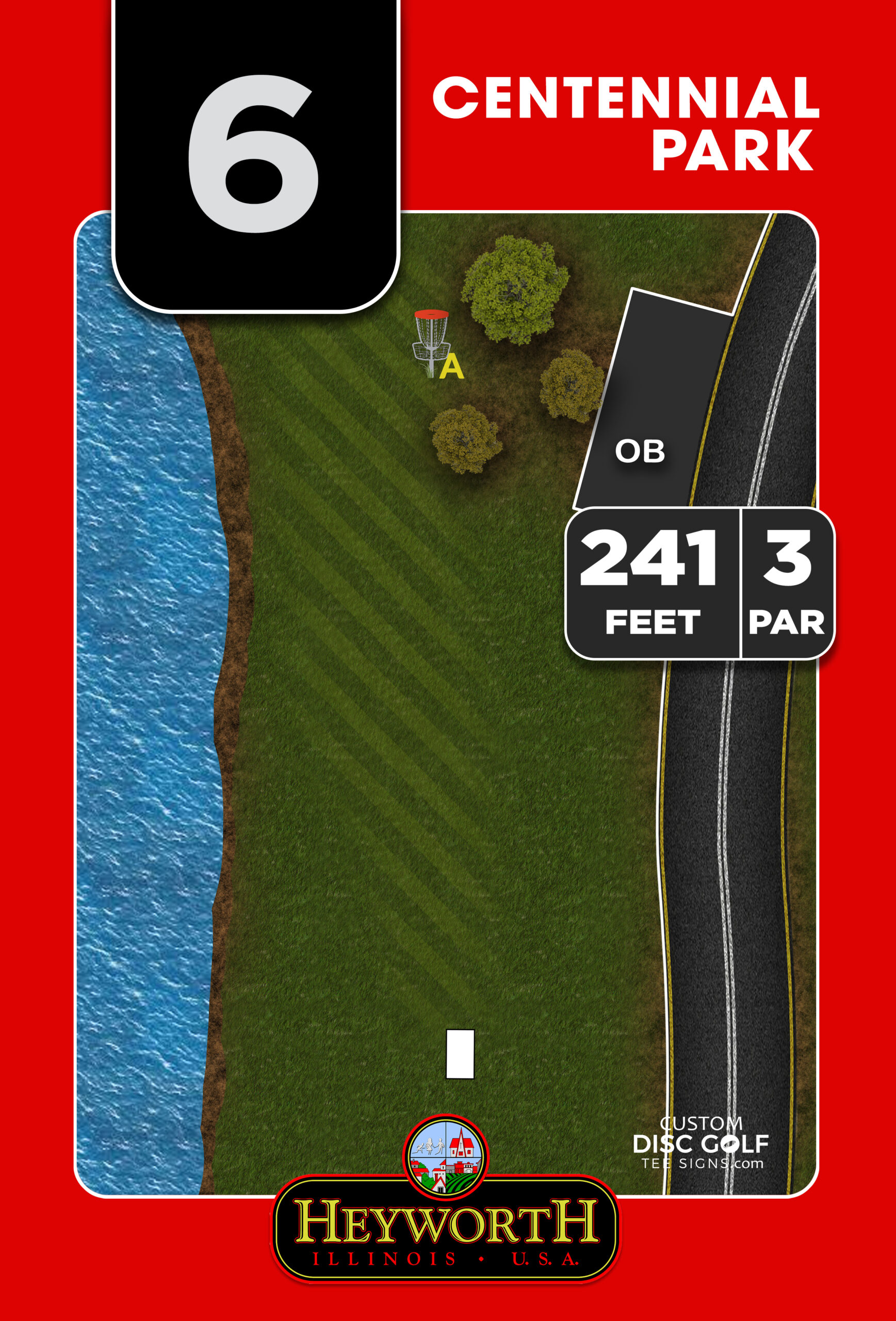
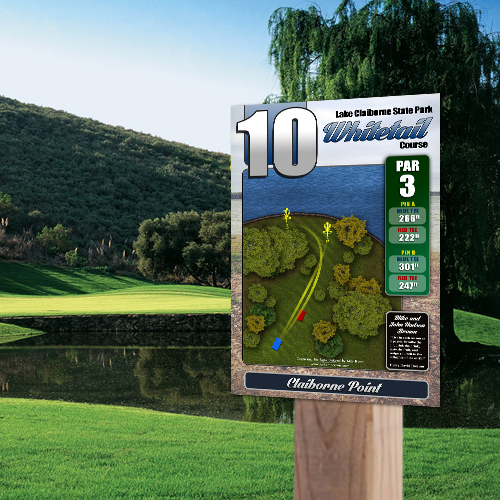
Full-color tee signs use color to organize information. A blue water feature reads as water immediately. Green fairway areas, shaded rough, red out-of-bounds markings, directional arrows, and distinct tee or pin locations help players interpret a layout quickly. Color is not decoration when it is used with purpose. It is a navigation tool.
This advantage is especially meaningful on championship-caliber courses and properties with mixed skill levels. Newer players often rely on the hole map to understand a safe route. Experienced players may use it to identify a preferred landing zone, alternate basket placement, or a hidden hazard. A high-resolution, course-specific layout lets both groups make better decisions before stepping onto the tee.
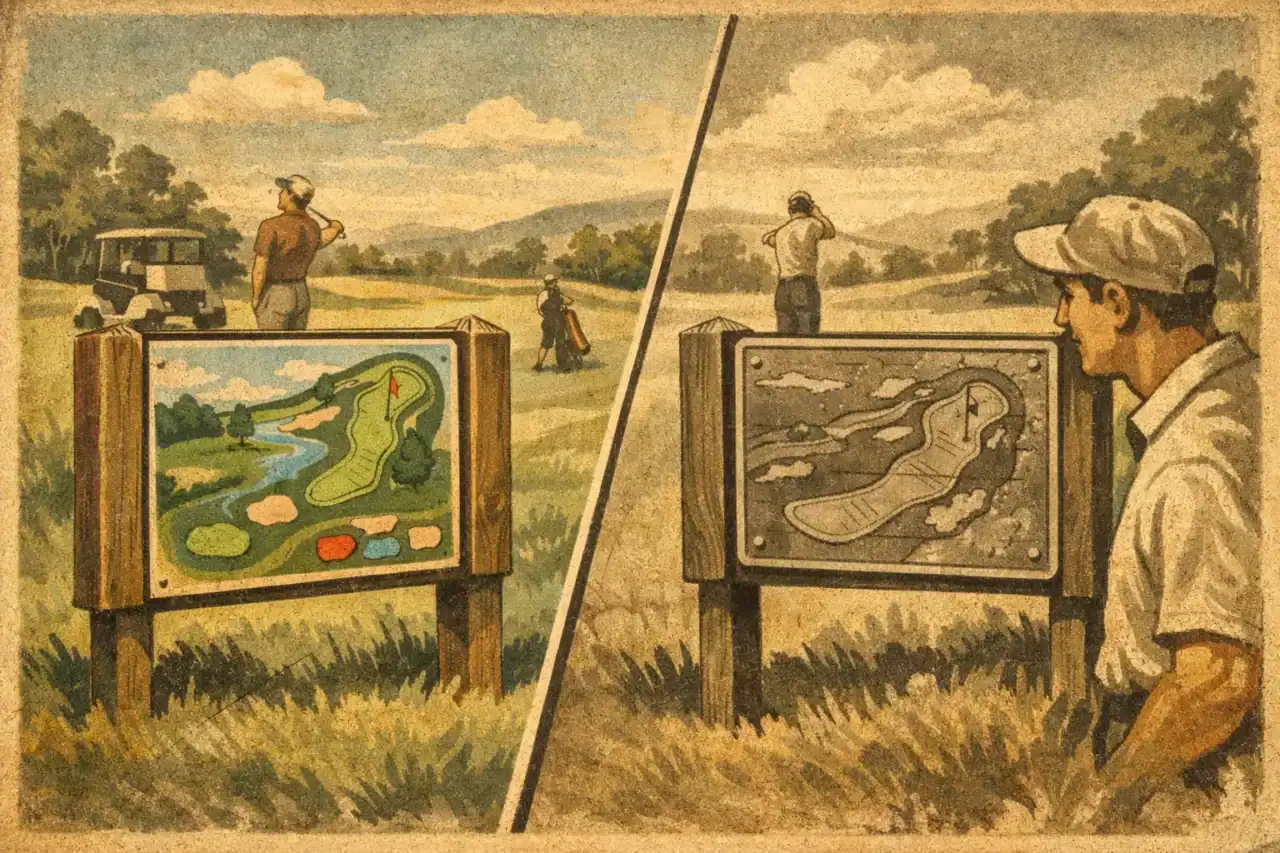
Engraved signs typically create contrast through etched lines, recessed areas, or limited fill colors. They can look clean and permanent, but their diagrams must remain simple to stay readable. Fine contour details, overlapping lines, multiple hazard types, and sponsor artwork can become visually crowded without the separation that full color provides.
Visibility also depends on the sign’s placement, size, finish, and orientation. A professionally designed full-color sign should use strong contrast, legible type, and an uncluttered information hierarchy. More color does not automatically mean a better sign. The artwork must be built for outdoor reading at tee-pad distance, not treated like a brochure or a busy map.
Design Flexibility and Course Branding
Every course has its own identity. A city park may need signage that aligns with municipal branding. A private course may want a premium, destination-course presentation. A club may want to feature its logo, league identity, local landmarks, or tournament-ready layouts. Full-color signs give you more room to make those elements feel integrated rather than added on.
With a custom full-color system, each hole can include a precise layout while the full course maintains a consistent visual language. Course logos, hole numbers, distances, pars, rules, safety notes, and next-tee instructions can all follow the same structure. That consistency helps players trust the information because they know where to look on every sign.
Engraved signs are often better suited to a restrained aesthetic. They can work well for courses that want a classic park marker look or have only a few essential data points to display. If your existing property signage is engraved metal, matching that system may be a reasonable priority.
The trade-off is flexibility. Updating a hole map, changing an alternate pin location, refreshing a logo, or adding sponsor recognition is usually easier to plan into a full-color graphic workflow. For a course that evolves over time, that flexibility has real value.
Durability Is About Materials and Production, Not Just Engraving
It is easy to assume engraved signs are always the durable option because the information is physically cut into the material. Engraving can perform well, but durability should be evaluated by the entire sign construction: substrate, ink or finish, UV protection, mounting method, exposure, and expected maintenance.
Quality full-color tee signs produced on durable aluminum composite or aluminum substrates are built for outdoor use. UV-protected printing helps resist fading, while weather-resistant materials stand up to rain, heat, temperature shifts, and routine course use. For most disc golf facilities, a professionally produced full-color sign provides the long-term performance needed for a reliable tee system.
Engraved signs can also weather well, but they are not maintenance-free by default. Dirt can settle into etched areas, lighter fills can lose contrast, and surface wear may affect readability over time. A sign that survives physically but becomes difficult to read is no longer doing its job.
The practical question is not, “Which option lasts forever?” It is, “Which sign system will remain clear, useful, and on-brand in our specific environment?” A shaded wooded course, an exposed high-sun property, a coastal environment, and a heavily used public park may each have different material considerations.
Sponsorship Value Often Favors Full Color
For clubs, municipalities, and volunteer-led projects, sponsorship can turn a difficult signage budget into an achievable plan. A well-placed sponsor area gives local businesses meaningful visibility while keeping the hole information front and center. It can also create a repeatable model for future course upgrades.
Full color makes sponsor integration more polished. Business logos can retain their recognizable colors, the sponsor section can be visually separated from the hole map, and the overall sign still looks cohesive. This matters when you are asking a local restaurant, bank, contractor, brewery, or other community business to support the course.
Engraved sponsor recognition is possible, but it may reduce logo detail or limit the visual impact a sponsor expects. If sponsorship is a significant part of the funding plan, full-color signs usually provide a stronger value proposition for both the course and the business supporting it.
A clear sponsorship program also protects the player experience. Sponsor space should be planned intentionally, not squeezed into the map at the last minute. The sign should still prioritize the player’s route, distance, hazard information, and tee navigation.
Budget: Consider the Full Project, Not Only Unit Cost
A lower initial cost can be attractive, especially for a volunteer-funded course or public project with a fixed allocation. But choosing a tee sign system solely by unit price can create problems later. If a basic engraved sign does not show enough route information, you may need supplemental directional signs, temporary notices, or frequent player assistance. That has a cost too.
Full-color signs may offer a better return when they replace confusion with clear communication and create room for sponsor revenue. They can also support a tiered project approach. A course may begin with essential navigation and hole maps, then add premium course overview signs, rules boards, directional signs, or custom-shaped feature signs as funding becomes available.
Your design process matters here. Course-specific artwork, accurate hole information, proofing before production, and a coordinated sign package reduce the risk of ordering signs that look good individually but fail to work together on the course. A strong partner will help organize the information, account for sponsors, and guide the project from design through delivery.
When Engraved Tee Signs Are the Better Choice
Engraved signs are a sensible choice when the course has straightforward holes, limited information needs, and a property-wide engraved aesthetic. They may also fit projects where a minimal presentation is intentional and the course already has clear navigation through other means.
For example, a small nine-hole course with open fairways, fixed baskets, and simple distances may not need detailed full-color route maps at every tee. In that setting, an engraved sign with the hole number, par, distance, and basic diagram can be enough.
The key is not to choose simplicity by habit. Choose it because the course genuinely requires less information.
Choose the Sign That Helps the Course Perform Better
The best choice between full-color and engraved tee signs begins with the player’s view from the pad. If the hole has hazards, multiple routes, pin changes, blind landings, sponsor support, or a need for stronger branding, full color gives you the clarity and flexibility to bring the course to a higher standard. If the course is simple and a minimal, traditional marker matches the property, engraving can be a practical fit.
Before committing, walk every hole as a first-time player would. Notice where questions arise, where routes are unclear, and where a better sign could prevent a bad decision before the disc ever leaves a player’s hand.