How Many Signs Does a Course Need for Disc Golf?
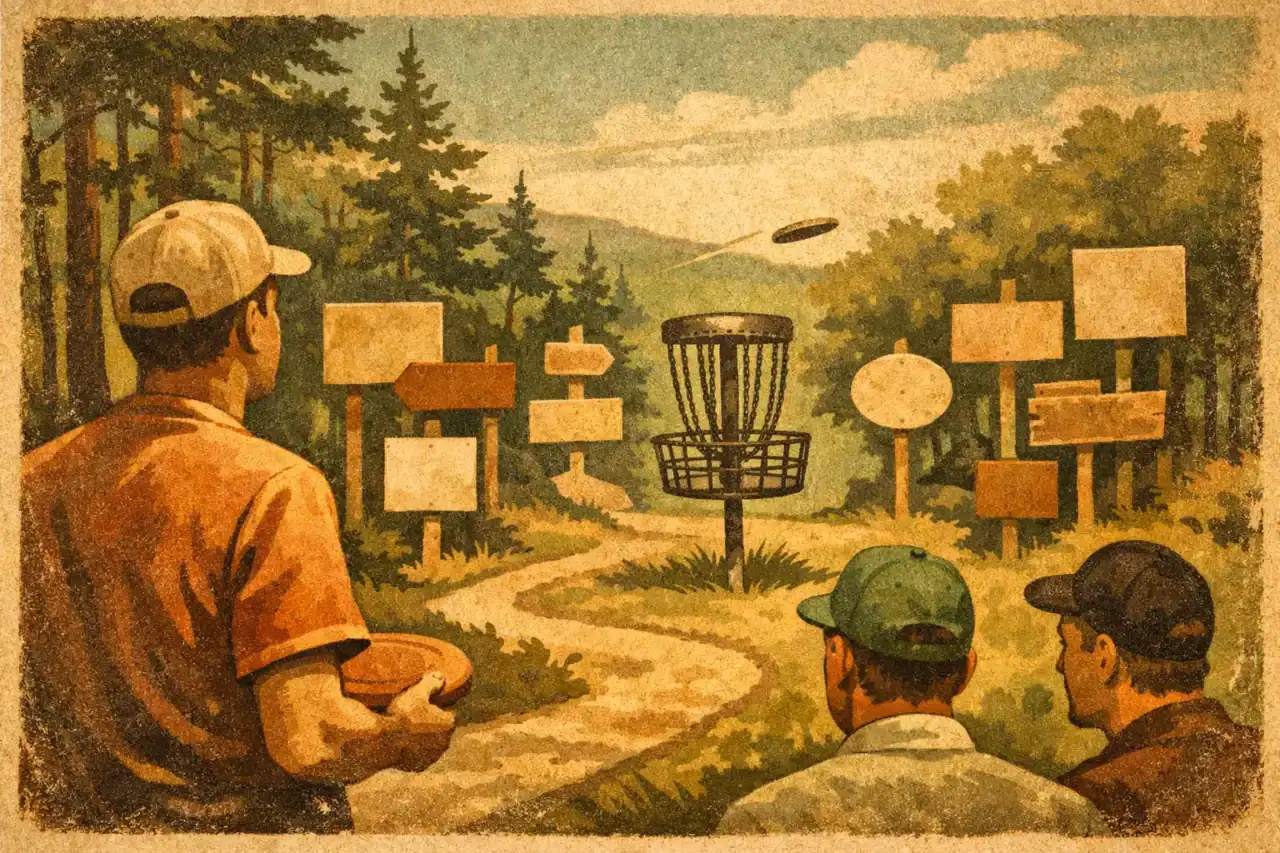
A player standing at hole 7 should not have to guess where the next tee is, wonder whether the basket is beyond the trees, or walk back to the parking lot to find a course rule. That is the practical answer behind the question, how many signs does a course need: enough signs to make every key player decision clear without cluttering the landscape.
For most courses, the answer is more than one sign per hole. Tee signs are the foundation, but they do not solve navigation between holes, establish expectations at the entrance, identify amenities, or help first-time visitors understand the property. A complete sign plan gives players confidence from the moment they arrive and helps course managers present a more organized, professional facility.
How Many Signs Does a Course Need? Start With the Layout
There is no universal sign count that works for every disc golf course. A compact nine-hole course with obvious transitions may need a basic system of 12 to 18 signs. A wooded 18-hole course with long walks between holes, multiple parking areas, alternate tees, and tournament traffic may need 35 to 60 signs or more.
The right count depends on the number of holes, course terrain, transition difficulty, player volume, and the level of experience you want to deliver. A course built for casual park use has different needs than a championship layout that hosts leagues, visiting players, and sanctioned events.
A useful planning framework includes four sign types:
- Tee signs at each playable hole
- Directional signs wherever the route to the next tee is not immediately obvious
- Course maps and welcome signs at entrances, parking areas, or major decision points
- Rule, safety, amenity, and sponsor signs where they provide useful information
This approach avoids a common mistake: ordering 18 attractive tee signs, then realizing the course is still difficult to navigate.
The Essential Signage for Every Disc Golf Course
Tee signs: one for every teeing area
At minimum, every primary tee should have a dedicated tee sign. On an 18-hole course, that means 18 signs. On a nine-hole course, it means nine. If your layout has separate long and short tees, beginner tees, or permanent alternate layouts, each distinct teeing location should have its own sign or a clearly visible shared sign that removes any doubt about the intended line of play.
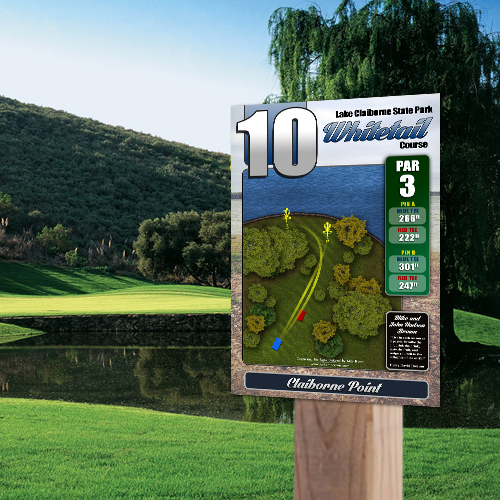
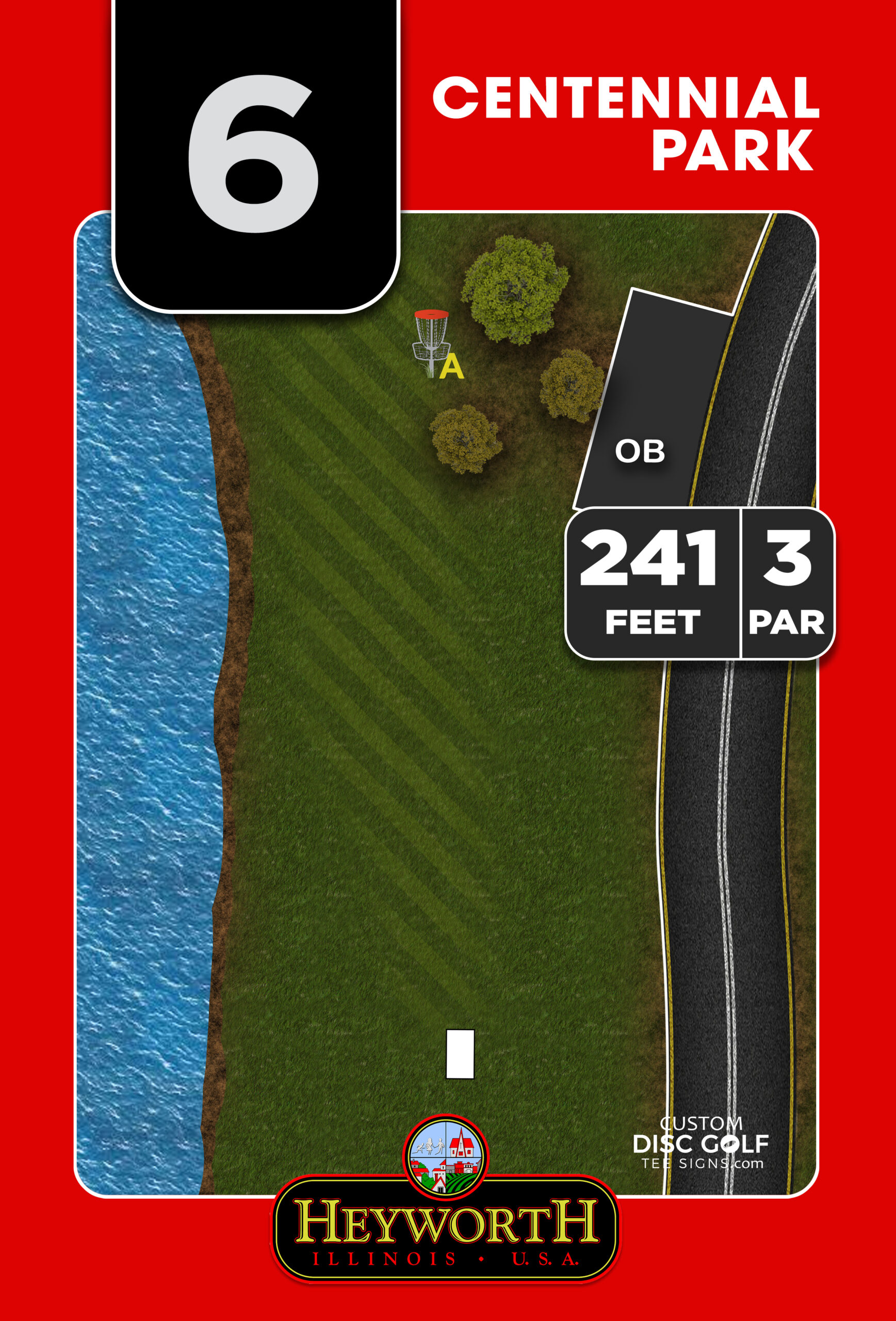
A quality tee sign should do more than display a hole number and par. Players benefit from a clear hole map, distance, target location, out-of-bounds areas, hazards, mandatories, and any feature that affects strategy or safety. On courses with multiple baskets or pin positions, the sign design should make current and alternate configurations easy to interpret.
Tee signs are also the most natural place for sponsor placement. A well-designed sponsor area can help a club, municipality, or volunteer project offset signage costs while keeping the hole information front and center.
Directional signs: add them where players hesitate
Directional signs are not about filling every trail with arrows. They are for the moments when a player can reasonably take the wrong path. Walk the course as if you have never played it before, especially after holes that finish near other fairways, roads, playgrounds, trails, or multiple paths.
Place a next-tee arrow at the basket exit when the route is unclear. Add a second confirmation sign if the walk is long or includes a turn. Directional signs are especially valuable on wooded properties, multi-use parks, and courses with non-sequential routing.
An 18-hole course often needs six to 15 directional signs, but that number can rise quickly on a property with long transitions. If players regularly ask, “Where is hole 12?” the course needs a sign at the point where the answer matters, not simply another note on the tee sign behind them.
Course maps and welcome signs: orient players before the first throw
A course overview sign is one of the highest-value additions to a public course. Place it near the main parking area, first tee, or kiosk where players naturally pause before starting. It should show the full course layout, parking, restrooms, practice areas, emergency access points, and important park boundaries.
Larger facilities may benefit from more than one map. Consider a second overview near a secondary entrance, a split point between course loops, or a tournament check-in area. This is particularly useful when players can begin at different holes or when the course has a front nine and back nine that are separated by roads or open space.
Welcome signs can also communicate course etiquette, hours, contact information, emergency guidance, and park rules. Keep the message focused. A sign packed with paragraphs will be ignored, while a clean layout with readable priorities helps players understand the property quickly.
Safety, amenity, and rules signs: use them deliberately
Some signs are not tied to a specific hole, but they still protect the player experience. Rules and safety signs are appropriate near entrances, shared-use areas, water hazards, roads, and locations where disc flight could create a concern. Amenity signs can point visitors toward restrooms, water, practice baskets, picnic areas, or accessible paths.
The goal is not to cover the course with warnings. It is to communicate the information a player needs before a poor decision becomes a problem. For example, a clear sign identifying a pedestrian trail crossing near a blind fairway is more useful than a generic warning posted far from the hazard.
A Practical Sign Count for 9- and 18-Hole Courses
For a straightforward nine-hole course, begin with nine tee signs, one course map or welcome sign, two to five directional signs, and one to three rule or amenity signs. That produces a realistic baseline of 13 to 18 signs.
For a typical 18-hole course, start with 18 tee signs, one or two course maps, six to 15 directional signs, and two to five rule, safety, or amenity signs. Most projects in this category land between 27 and 40 signs.
A more complex 18-hole course may require 40 to 60 signs when it includes multiple tees, alternate pin placements, several entry points, difficult transitions, extensive park rules, or tournament infrastructure. Championship-level signage may also include practice area signs, event boards, spectator guidance, division-specific tee markers, and sponsor recognition panels.
These ranges are planning tools, not fixed rules. An open course with short, visible walks may need fewer directional signs. A heavily wooded course with elevation changes can need more signs even if it has fewer holes.
Build the Plan by Walking the Player Journey
The most reliable way to determine your exact sign count is to walk the entire course in order. Begin in the parking lot and document each point where a new visitor needs information. Do not evaluate the course only from the perspective of someone who already knows the layout.
At every hole, ask whether the tee is easy to find, whether the hole information is complete, and whether the route to the next tee is obvious after putting out. Take photos of confusing intersections, long transitions, alternate tees, and areas with poor sightlines. These become the foundation for a sign placement plan and design proofing process.
It also helps to separate must-have signs from phase-two improvements. If budget is limited, prioritize primary tee signs, the main course map, and the directional signs that solve genuine navigation failures. Add premium amenities, secondary maps, and expanded sponsor displays as funding allows. A phased project can still look coordinated when all signs share a consistent visual system.
Choose Durable Materials and Clear Information
The number of signs matters, but performance matters just as much. A faded, warped, or hard-to-read sign does not improve the course for long. Disc golf signage should be built for sun exposure, weather, impacts, and routine park maintenance.
Durable UV-protected aluminum composite and aluminum signs are strong choices for permanent installations. They hold full-color hole maps, custom artwork, sponsor graphics, and detailed course information while standing up to outdoor conditions. The best material and mounting approach depends on your environment, local vandalism concerns, and whether the course needs signs that can be updated as layouts change.
Design clarity should guide every decision. Use high-contrast colors, readable type, clear arrows, and hole maps that show the fairway shape without becoming visually busy. Custom Disc Golf Tee Signs can help turn course measurements, photos, layout files, and sponsor requirements into a coordinated proof package before production begins.
A well-planned sign system lets players focus on the round, not on finding their way. Start with the decisions visitors must make from the parking lot through the final basket, then give each of those decisions a clear, durable answer.